
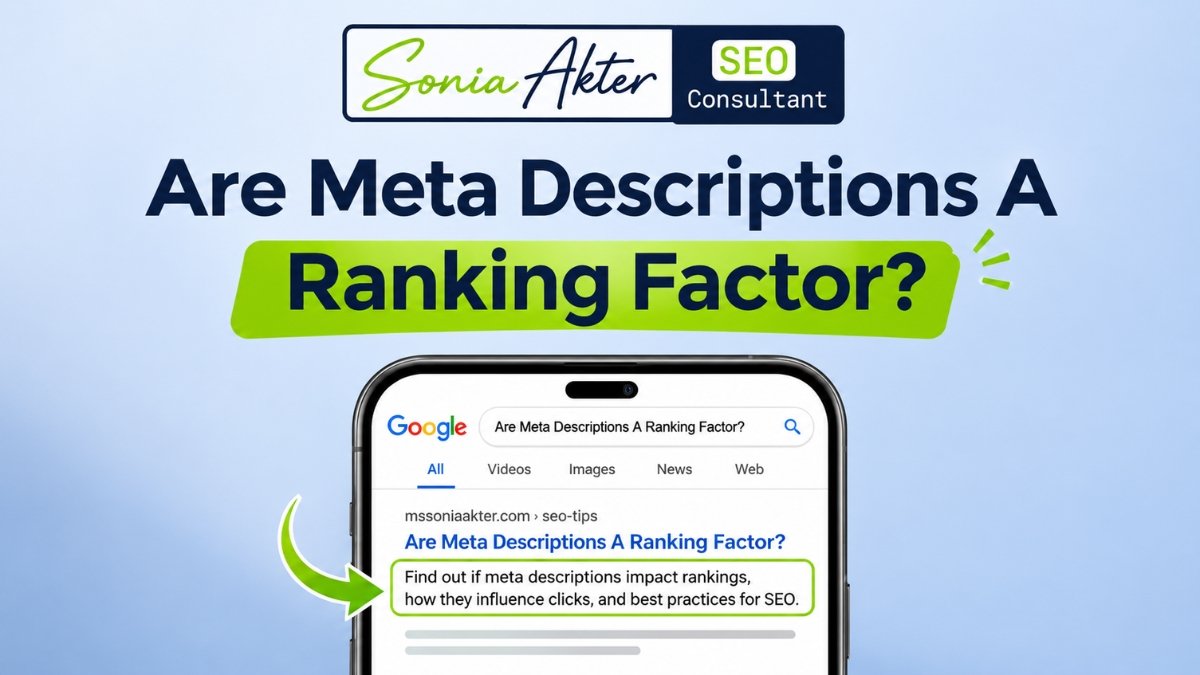
Many website owners spend a surprising amount of time rewriting meta descriptions because they believe adding the right keywords will push a page higher in Google.
That sounds reasonable. The meta description appears beneath the title in many search results, so it feels like something Google should use when deciding rankings.
But that is not how it works.
Meta descriptions are not a direct Google ranking factor. Google has stated that it does not use the meta description tag to rank pages. However, that does not make meta descriptions useless. A clear and relevant description can help searchers understand your page and may encourage more of them to click your result.
The important distinction is simple:
A meta description may help you earn more clicks, but it does not directly move your page to a higher ranking position.
Understanding that difference can save you from wasting time on the wrong SEO activities.
What Is a Meta Description?
A meta description is a short summary added to the HTML of a webpage.
It usually looks like this:
<meta name=”description” content=”Learn whether meta descriptions affect Google rankings and how to write descriptions that attract more organic clicks.”>
Google may display this text beneath your page title in search results.
However, the description you write is not guaranteed to appear. Google primarily creates search snippets from the visible content of the page. It may use your meta description when that description provides a more accurate or useful summary for the searcher.
This is where many beginners become confused. They write a description, search for their page, and discover that Google is showing a different sentence.
That does not necessarily mean something is broken.
Google may rewrite the snippet based on:
- The user’s search query
- The visible content of the page
- The relevance of a specific paragraph
- The device and available display space
- Whether the written description accurately represents the page
The same page may therefore show different snippets for different searches.
Are Meta Descriptions a Ranking Factor?
No. Meta descriptions are not a direct Google ranking factor.
Adding your target keyword to a meta description does not automatically make the page rank higher. Rewriting the description repeatedly will not solve problems caused by weak content, poor search-intent alignment, low-quality backlinks, technical indexing issues, or strong competition.
Google’s documentation treats the meta description as information that may be used to create a search-result snippet. It is not presented as a signal that determines where the page ranks.
This means two pages can have equally good meta descriptions while ranking very differently.
The difference may come from factors such as:
- How completely each page answers the search query
- The quality and originality of the main content
- Internal and external links
- Page experience and mobile usability
- Website authority and topical relevance
- Crawlability and indexability
- Competition for the keyword
A strong meta description cannot compensate for a weak page.
Why Do Meta Descriptions Still Matter?
Although meta descriptions do not directly improve rankings, they can still affect your organic search performance.
Think of the ranking position as getting your page onto the shelf. The title and description then help the searcher decide whether to pick it up.
A good description can:
- Explain what the page offers
- Show that the result matches the user’s intent
- Differentiate the page from competing results
- Set accurate expectations before the click
- Attract more relevant visitors
Google describes a good meta description as a short and relevant summary that informs and interests users. It can function like a pitch showing why the page matches what the searcher needs.
The benefit is not that Google rewards the description with a higher position. The benefit is that a better snippet may make the existing position more useful.
For example, imagine two results ranking next to each other.
Weak description:
Meta descriptions and SEO. Read our complete article to learn more.
Stronger description:
Meta descriptions do not directly affect Google rankings. Learn what they influence, why Google rewrites them, and how to write one that earns relevant clicks.
The second version gives the searcher a clearer reason to visit.
The Common Problem: Writing for Google Instead of the Searcher
A frequent SEO mistake is treating the meta description as a place to insert as many keywords as possible.
For example:
Meta description ranking factor, meta description SEO, Google ranking meta description, best meta description ranking tips.
This is not persuasive. It sounds unnatural, provides little useful information, and may not be selected by Google as the search snippet.
The deeper problem is misplaced effort.
Some website owners spend hours adjusting descriptions while ignoring the page itself. But the page may still have:
- A vague introduction
- Thin or repetitive content
- No direct answer to the main question
- Poor heading structure
- Missing examples
- Outdated information
- A mismatch with search intent
A carefully written description cannot fix those weaknesses.
The description should support the page. It should not be expected to carry the page.
The Solution: Improve the Page First
Before rewriting a meta description, check whether the main content deserves to rank.
For a query such as “Are meta descriptions a ranking factor?”, the reader probably wants several things:
- A direct yes-or-no answer
- An explanation of what meta descriptions actually do
- Clarification about clicks and rankings
- Advice for writing a useful description
- Information about Google rewriting snippets
A page that covers only one of these points may leave the user unsatisfied.
A better process is:
Step 1: Answer the Main Question Immediately
Do not make the reader scroll through a long introduction.
State the answer near the beginning:
Meta descriptions are not a direct Google ranking factor, but they can improve how your result is presented and may help attract relevant clicks.
This confirms that the page matches the search intent.
Step 2: Build Helpful Main Content
Explain the topic fully enough that the user does not need to return to Google immediately.
Cover the misconception, the practical value, Google’s snippet behavior, common mistakes, and writing recommendations.
Step 3: Write the Meta Description Last
Once the article is complete, summarize its real value.
This is usually easier and more accurate than writing the description before the content exists.
Step 4: Compare It With Competing Results
Search the target query and examine how competing pages present themselves.
Do not copy their descriptions. Look for information they fail to communicate.
Your description may stand out by being:
- More direct
- More specific
- Easier to understand
- Better aligned with the search question
- Honest about what the page contains
How to Write a Good Meta Description
There is no single description formula that works for every page. However, a practical description usually includes four elements:
1. Match the Search Intent
The description should reflect what the searcher is trying to find.
For an informational article, summarize the answer and learning outcome.
For a product page, mention important product details.
For a service page, explain the service, audience, and location when relevant.
2. Describe the Actual Page
Do not promise information that is missing from the content.
A misleading description might attract a click, but it can also disappoint the visitor. That is not a useful SEO win.
3. Include the Main Topic Naturally
Using the target phrase can help users recognize that the result is relevant.
But the keyword should fit naturally. Repeating it does not create an extra ranking advantage.
4. Give the User a Reason to Click
Explain what makes the page useful.
Instead of:
Learn about meta descriptions in this article.
Try:
Learn whether meta descriptions affect Google rankings, why Google rewrites snippets, and how to write descriptions that attract qualified clicks.
The second description communicates a specific benefit.
Is There an Ideal Meta Description Length?
There is no fixed character limit that guarantees Google will display the complete description.
Google states that there is no formal limit on the length of a meta description, but search snippets may be shortened to fit the device width.
In practice, many SEO writers aim for approximately 140 to 160 characters because it encourages concise writing. This is a working guideline, not a Google ranking rule.
Do not remove useful information merely to reach an exact character count.
Focus on putting the most important message early. That way, the description can still make sense if the ending is truncated.
Why Does Google Rewrite Meta Descriptions?
Google primarily generates snippets from the content of the page. It may use your meta description when that description is a better representation of the page for the specific search.
A rewrite may happen when:
- The description is too generic
- The same description appears on many pages
- It does not match the query
- It does not accurately summarize the content
- A passage from the page provides a more relevant answer
- The description contains repetitive or unhelpful wording
You cannot force Google to show the exact description every time.
Your job is to provide a useful option and make sure the visible page content also contains clear, well-written summaries that Google can use.
Meta Description Mistakes to Avoid
Using the Same Description Everywhere
Every important page should have a description that reflects its specific content. Google recommends creating unique descriptions for individual pages.
Stuffing Keywords
A list of repeated keywords is difficult to read and does not provide a meaningful reason to click.
Making Unsupported Claims
Phrases such as “guaranteed results,” “number one solution,” or “rank instantly” can reduce trust, especially when the page cannot support those claims.
Ignoring the Search Intent
A description may be well written but still ineffective if it answers the wrong question.
Treating It as the Main SEO Strategy
Meta-description optimization should not replace content improvement, internal linking, technical SEO, or authority building.
Example Meta Description for This Article
Are meta descriptions a Google ranking factor? Learn the direct answer, what descriptions actually influence, and how to write one for better clicks.
This version includes the main question, gives a clear benefit, and avoids claiming that the description itself improves rankings.
Final Answer
Meta descriptions are not a direct Google ranking factor.
They will not rescue a weak page, replace useful content, or guarantee a better ranking. Their practical value is in helping searchers understand the result and decide whether the page is relevant to them.
The safest approach is to work in this order:
- Satisfy the search intent
- Create accurate and useful content
- Improve the title and on-page structure
- Write a clear meta description
- Monitor impressions and clicks in Google Search Console
Do not optimize the description as though it were a hidden ranking trick. Treat it as a clear, honest summary of a page that is already worth visiting.
That approach is less exciting than promises of instant rankings, but it is much closer to how search actually works.
Frequently Asked Questions
Do Keywords in Meta Descriptions Help Rankings?
Not directly. Google does not use the meta description tag as a ranking factor. Keywords may still help searchers see that your result matches their query, but repeating them will not provide a direct ranking boost.
Can a Better Meta Description Increase Traffic?
It may help a result attract more clicks by communicating relevance and value more clearly. However, results depend on the ranking position, search demand, competition, title, snippet selection, and how well the page matches the query.
Should Every Page Have a Meta Description?
Important pages should generally have unique and accurate descriptions. For very large websites, descriptions can be generated programmatically when the generated text remains specific, readable, and useful. Google explicitly allows programmatic descriptions for large database-driven websites.
What Happens If I Leave It Blank?
Google can generate a snippet from the page content. This sometimes works well, but writing a strong description gives Google another relevant summary to consider.
Does Google Always Show My Description?
No. Google may select text from the page when that text better matches the user’s search.