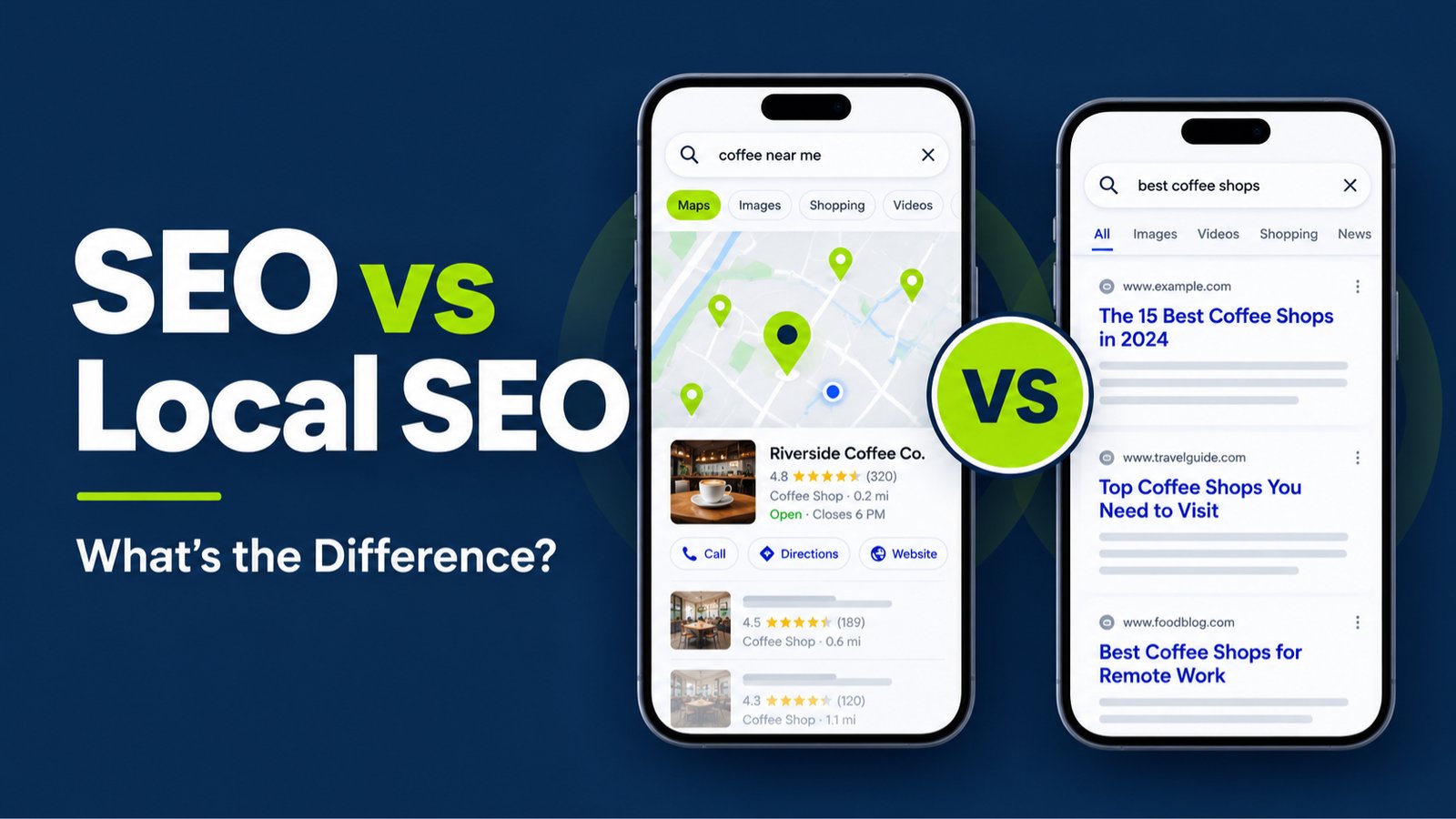
Your business has a website, but are the right customers finding it on Google?
Maybe you want to reach people across the country. Or perhaps you run a local business and need more calls, enquiries, and customers from nearby areas.
Both goals involve search engine optimization, but they require different approaches.
So, what is the difference between SEO and Local SEO?
The biggest difference is the audience you want to reach. Traditional SEO focuses on improving a website’s visibility in unpaid search results, while Local SEO focuses specifically on helping businesses appear in location-based searches, including Google Maps and local search results.
However, there is more to understand than location alone.
In this guide, you’ll discover how SEO and Local SEO work, their key differences, examples, benefits, and which strategy is right for your business.
SEO vs Local SEO: What’s the Main Difference?
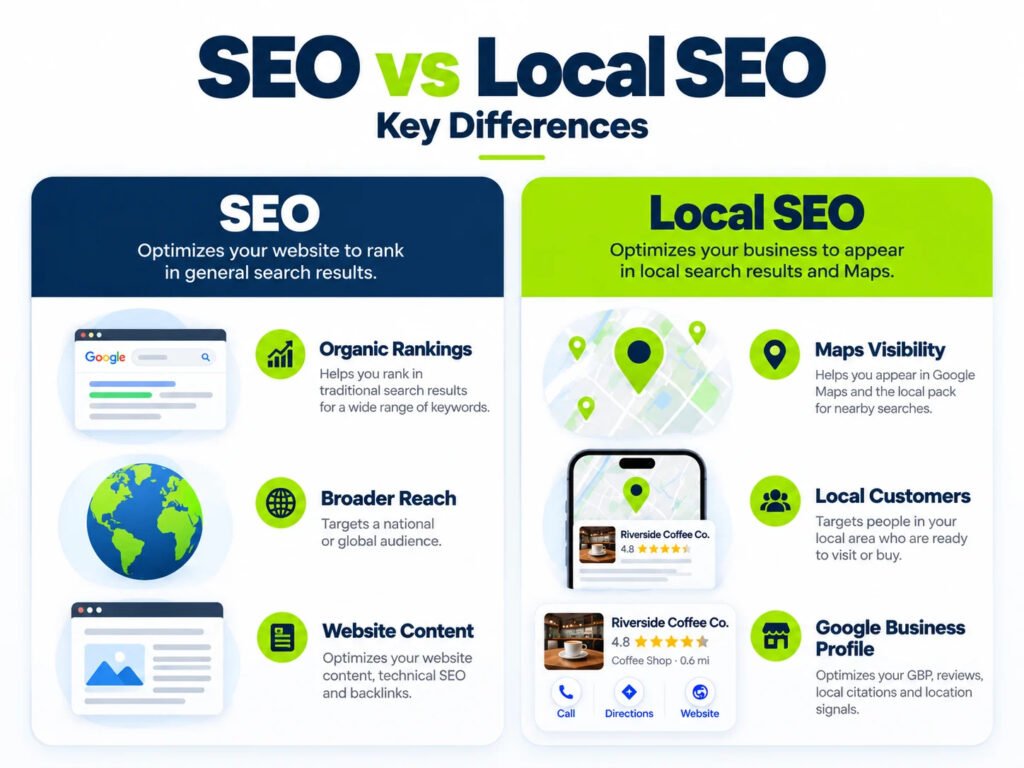
SEO (Search Engine Optimization) improves a website’s visibility in unpaid search results for relevant keywords. Local SEO is a specialized part of SEO that helps businesses connect with customers searching for products or services in a specific geographic area.
For example:
- Traditional SEO: Someone searches for “best project management software.”
- Local SEO: Someone searches for “best accounting firm near me.”
The first search doesn’t necessarily depend on where the person lives. The second search is strongly connected to their location.
Traditional SEO commonly focuses on website content, keywords, technical performance, and backlinks.
Local SEO uses many of those same practices but adds location-focused strategies such as Google Business Profile optimization, customer reviews, local citations, and location pages.
The important point is that Local SEO is not separate from SEO. It’s a specialized approach within SEO.
SEO vs Local SEO: Key Differences at a Glance
| Feature | Traditional SEO | Local SEO |
| Primary goal | Improve organic search visibility | Improve visibility for location-based searches |
| Target audience | Broader or location-independent audience | Customers in specific geographic areas |
| Keyword strategy | General and topic-specific keywords | Location-based and local-intent keywords |
| Search results | Primarily organic website listings | Local Pack, Google Maps and organic listings |
| Google Business Profile | Not generally required | Important for eligible businesses |
| Content focus | Guides, product pages, service pages | Local service pages, location pages, local information |
| Link building | Relevant industry and editorial links | Relevant local and industry links |
| Business reviews | Build trust and support conversions | Also influence local visibility |
| Competition | Businesses targeting similar queries | Often businesses serving the same area |
| Main outcomes | Organic traffic, leads and sales | Calls, directions, enquiries and local customers |
| Best for | SaaS, ecommerce, publishers and broad-reach brands | Restaurants, dentists, plumbers, salons and local service providers |
Both approaches require useful content, good website performance, and an understanding of search intent.
What Is SEO?
SEO stands for Search Engine Optimization. It is the process of improving a website so search engines can discover, understand, and present its content to relevant users.
The primary goal is to attract qualified visitors through unpaid search results.
For example, suppose you operate an online store selling office furniture throughout the United States.
Potential customers may search for:
- best ergonomic office chairs
- adjustable standing desk
- home office furniture ideas
Your website can target these searches through informative guides, category pages, and optimized product descriptions.
Since your customers can purchase products from different locations, your strategy does not need to focus exclusively on a single city.
How Does Traditional SEO Work?
Traditional SEO generally includes four major activities.
1. Keyword research
Identify relevant keywords your audience uses and understand the intention behind each search.
2. On-page optimization
Improve titles, headings, content, URLs, images, and internal links.
A strong On-Page SEO strategy helps organize your website around relevant search topics.
3. Technical optimization
Make important pages accessible to search engines while improving website usability, performance, and indexing.
4. Off-page SEO
Earn relevant backlinks, build brand recognition, and develop your website’s reputation.
These activities work together to improve your website’s ability to compete in organic search.
What Is Local SEO?
Local SEO is the practice of improving a business’s visibility for searches connected to a geographic location.
It helps people discover relevant businesses nearby or in an area they specifically mention.
For example:
- dentist in New York
- emergency plumber near me
- best coffee shop in London
- cleaning services in Dubai
Google may show local business listings, Maps results, and relevant organic website pages for these searches.
Unlike a general informational search, a local search often signals that the person wants to contact, visit, or book a business.
This makes Local SEO particularly useful for companies that serve customers in specific communities.
How Does Local SEO Work?
Local SEO combines traditional website optimization with local business information.
Important elements include:
Google Business Profile
An eligible business can maintain a Google Business Profile containing relevant contact details, services, categories, opening hours, and other useful information.
Location-based keywords
Local businesses target search phrases that describe both their services and where those services are offered.
Customer reviews
Genuine customer reviews can build trust and contribute to local search visibility.
Local citations
Relevant business listings help people discover accurate information about a company.
Location-specific pages
Useful location or service-area pages explain what a business offers in the areas it genuinely serves.
Local backlinks
Links from relevant community organizations, industry associations, and local publications can support business discovery and reputation.
Local SEO is especially valuable when a business wants enquiries from customers in its actual service area.
7 Key Differences Between SEO and Local SEO
Understanding these differences makes it easier to choose a strategy that matches your business goals.
1. Target Audience and Geographic Reach
Traditional SEO can help a business reach customers across multiple cities, countries, or international markets.
Local SEO targets customers searching within particular geographic areas.
For example, an online software company can serve customers worldwide.
A plumbing business operating in Dallas primarily needs customers within its service area.
The software company may prioritize broad informational and commercial keywords.
The plumber should focus on searches such as “emergency plumbing services in Dallas.”
Key difference: Traditional SEO can support broad visibility, while Local SEO specifically targets location-based demand.
2. Keyword Research and Search Intent
Both strategies rely on keyword research, but their keyword priorities are different.
Traditional SEO keywords might include:
- how to improve website speed
- best accounting software
- affordable running shoes
Local SEO keywords might include:
- accountant in Chicago
- running shoe store near me
- website design agency in Miami
Local intent can also be implicit.
Someone searching for “pizza delivery” may see nearby businesses even without typing a city name.
This means Local SEO involves understanding both the search term and the location-related intent behind it.
3. Search Engine Results
One of the clearest differences between SEO and Local SEO is where businesses can appear.
Traditional SEO frequently targets unpaid website listings in search results.
Local SEO may target those listings as well as Google Maps and the Local Pack.
The Local Pack is a group of local business results that Google may display for geographically relevant searches.
These listings can show business names, reviews, locations, and other relevant details.
Google determines local rankings mainly using three factors:
- Relevance: How closely a business matches the search.
- Distance: How far the business is from the searcher’s relevant location.
- Prominence: How well-known and established the business is.
You can improve business information and visibility, but you cannot directly control your physical distance from every potential customer.
4. Google Business Profile Requirements
Traditional SEO doesn’t generally require a Google Business Profile.
For example, an online publication can build organic search visibility without having an eligible local storefront.
However, a Google Business Profile is a major component of Local SEO for eligible businesses.
It allows a company to manage important information that may appear on Google Search and Maps.
Useful profile details include:
- Business name and category
- Address or service area, as applicable
- Phone number
- Business hours
- Services and products
- Photos
- Customer reviews
Business owners should follow Google’s eligibility and representation guidelines.
Not every online-only business qualifies for a Business Profile.
5. Content Optimization
Traditional SEO content often targets broad informational or commercial topics.
A fitness ecommerce brand might publish an article titled “How to Choose the Best Running Shoes.”
A local running store could also create helpful educational content, but its Local SEO strategy may include:
- Running shoe fitting services in Boston
- Store location and opening hours
- Available in-store services
- Information about local events
Both approaches benefit from helpful, original content.
However, Local SEO content should provide genuine geographic relevance rather than repeatedly inserting city names into generic text.
6. Backlinks, Citations, and Reviews
Traditional SEO places importance on relevant editorial backlinks, useful content, and website reputation.
Local SEO also benefits from relevant backlinks but gives additional attention to local business listings and reviews.
For example, a local law firm may benefit from an accurate listing in a reputable legal directory.
A local restaurant may benefit from genuine reviews and mentions in relevant community publications.
A citation is generally an online mention of business details, such as its name, address, or phone number.
Not every citation or backlink has equal value.
Focus on accuracy, relevance, and trustworthy sources rather than building large numbers of low-quality listings.
7. Performance Measurement
The final difference involves how businesses measure success.
Traditional SEO performance often includes:
- Organic search clicks
- Organic-search sessions
- Search impressions
- Keyword visibility
- Leads and online sales
Local SEO may also track:
- Google Business Profile interactions
- Calls from local customers
- Direction requests
- Website visits from local searches
- Enquiries within target service areas
- Local keyword visibility
A national ecommerce store may care primarily about online purchases.
A local dentist may value appointment enquiries and qualified phone calls more than overall website traffic.
The most useful SEO strategy is the one that attracts the right customers and supports measurable business outcomes.
Local SEO vs National SEO: Are They the Same as SEO vs Local SEO?
Not exactly.
Traditional SEO is a broad category that can support local, national, or international search visibility.
National SEO refers specifically to strategies that target customers across a country instead of focusing on a limited local service area.
Consider three examples:
| Business | Primary Audience | Suitable Approach |
| Neighborhood coffee shop | Nearby residents and visitors | Local SEO |
| Nationwide ecommerce retailer | Customers throughout the country | National SEO |
| Dental clinic with educational blog | Local patients and wider informational audience | Local SEO + Traditional SEO |
Some businesses need both approaches.
For instance, a dental clinic might optimize its service pages for “dentist in Austin” while publishing educational articles about oral hygiene.
The location-focused pages help reach nearby patients, while the informational articles can attract broader organic search traffic.
Which Is Better: SEO or Local SEO?
Neither SEO nor Local SEO is automatically better.
The best choice depends on your target audience, business model, and how customers find your services.
Choose Traditional SEO When:
- You sell products or services to a broad geographic market.
- Your business operates primarily online.
- Your customers don’t need to visit a physical location.
- You want to build topical authority through helpful content.
- Your main objective is wider organic search visibility.
Examples include SaaS companies, online education platforms, publishers, and national ecommerce stores.
Prioritize Local SEO When:
- You operate a physical location customers can visit.
- You serve clients within a defined geographic area.
- Nearby customers frequently search for your services.
- You want more local enquiries, appointments, or calls.
- Your business competes with other local providers.
Examples include restaurants, home service businesses, dentists, salons, and local law firms.
Use Both When:
- You have multiple business locations.
- You provide local services and publish informational content.
- You want local enquiries alongside broader website traffic.
- Your company serves both local and national customers.
For many service businesses, combining traditional SEO fundamentals with location-focused optimization is the most practical approach.
How to Build an SEO and Local SEO Strategy Together
You don’t need completely separate marketing systems for each strategy.
Start with a strong website foundation, then adapt your optimization to the people and places you serve.
1: Identify Your Ideal Customers
Determine where your customers live, what problems they need solved, and how they search for solutions.
For example, a home renovation company should identify the neighborhoods and cities it genuinely serves.
2: Research General and Local Keywords
Group keywords by search intent.
For example:
General keyword: bathroom renovation cost
Local keyword: bathroom renovation contractors in Houston
You may need separate pages because the searches represent different needs.
3: Optimize Your Most Important Website Pages
Create clear, useful service pages with descriptive headings, relevant content, and logical navigation.
Use On-Page SEO best practices to help search engines and potential customers understand what each page offers.
4: Optimize Your Google Business Profile
If your business is eligible, ensure your profile accurately represents your services, business category, location, hours, and contact information.
Don’t create fake listings or use misleading business names.
5: Create Useful Local Content
Develop content that answers genuine questions from customers in your service area.
A roofing company could explain common roof problems associated with weather conditions in the region it serves.
Avoid doorway pages or nearly identical city pages created only to target variations of the same keyword.
6: Improve Website Performance and Internal Linking
Make important pages easy to navigate and usable on mobile devices.
Connect related informational articles, service pages, and appropriate location pages with descriptive internal links.
7: Build Trust and Local Visibility
Earn links from relevant websites, maintain accurate business information, and encourage genuine customer reviews without offering prohibited incentives.
8: Track the Results
Use Google Search Console and Google Analytics 4 to monitor search traffic and website enquiries.
For local businesses, review Google Business Profile performance and relevant calls or booking enquiries as well.
Don’t rely only on ranking positions. Evaluate whether your strategy is bringing the right customers.
Common SEO and Local SEO Mistakes to Avoid
Even a well-designed website can struggle with visibility if its optimization doesn’t match the business’s actual audience.
Ignoring local search intent: A local service provider may miss relevant customers by targeting only broad keywords.
Neglecting traditional SEO: A Google Business Profile doesn’t replace a useful, technically accessible website.
Keyword stuffing: Repeating city names unnecessarily creates poor content and doesn’t guarantee better rankings.
Creating duplicate location pages: Every location page should offer real, useful information about the business’s presence or services in that area.
Using incorrect business information: Inaccurate contact details can make it harder for customers to reach you.
Buying fake reviews or low-quality backlinks: Manipulative practices can damage trust and may violate platform policies.
Measuring only traffic: Calls, appointments, enquiries, and conversions are often more meaningful than visitor counts alone.
A professional SEO audit can help identify which problems deserve attention first.
Final Thoughts: SEO vs Local SEO — Which Should You Choose?
Understanding what is the difference between SEO and Local SEO helps you invest in a strategy that matches your customers and business goals.
Traditional SEO helps improve your website’s visibility for relevant organic searches, often across wider markets.
Local SEO builds on those foundations to help customers discover businesses in specific geographic areas through Google Search, Google Maps, and local results.
If your business operates primarily online, a broader SEO strategy may be your priority.
If your customers are searching for nearby services, Local SEO should be a major part of your plan.
And if you serve local customers while building a broader online presence, combining both strategies can help you reach more relevant audiences.
The goal isn’t simply to rank for more keywords. It’s to reach people who are genuinely interested in what your business offers.
Want to know which SEO strategy fits your website?
Start with a Free SEO Audit to identify potential issues, keyword opportunities, and practical ways to improve your search visibility.
Frequently Asked Questions About SEO vs Local SEO
Is Local SEO better than traditional SEO?
Local SEO is better suited to businesses targeting nearby customers. Traditional SEO is useful for reaching broader or location-independent audiences.
Can I do SEO and Local SEO together?
Yes. Combining both can improve general organic visibility while helping customers discover your business in local searches.
Is Google Business Profile necessary for Local SEO?
It’s important for eligible businesses seeking Google Maps visibility, but a website can still optimize for local organic searches without one.
Does Local SEO help small businesses?
Yes. Local SEO can help small businesses connect with nearby customers searching for relevant products or services.
Is Local SEO only for physical stores?
No. Eligible service-area businesses, such as plumbers and electricians, can also benefit from Local SEO.
Does traditional SEO help Google Maps rankings?
It can. Website relevance and visibility may support local performance, alongside Google Business Profile information and other local signals.
What is the difference between Local SEO and organic SEO?
Organic SEO focuses on unpaid website search visibility, while Local SEO focuses on location-related search visibility, including Maps and local listings.
How long does Local SEO take to work?
Results vary depending on competition, location, website quality, and business visibility. There is no guaranteed ranking timeline.
Can I do Local SEO without a website?
An eligible business can manage a Google Business Profile without a website, but a useful website provides additional opportunities for local organic visibility.
Which businesses need Local SEO most?
Businesses serving specific geographic areas, such as restaurants, medical practices, salons, and home service providers, often benefit from Local SEO.