
Your website ranks for relevant keywords. Your service pages explain what you offer. You’ve spent months publishing useful content.
But when someone asks ChatGPT to recommend a provider in your industry or uses Google AI Overviews to research a problem, your business may not appear.
That’s a different visibility problem from traditional search rankings.
People increasingly use AI-powered search experiences to compare services, investigate products, and understand complex topics. These systems can present direct answers, mention brands, and link to supporting sources before someone visits a website.
To improve AI search visibility, make your website technically accessible, publish clear and verifiable information, strengthen your brand’s online presence, and measure whether AI search experiences accurately mention or cite your content.
You don’t need to abandon traditional SEO or chase a secret AI ranking formula. You need to understand where conventional search optimization still matters, where AI-assisted discovery introduces new challenges, and which improvements you can actually control.
This guide explains 12 practical steps for improving your visibility across Google AI Overviews, ChatGPT Search, Perplexity, and other AI-powered discovery experiences.
What Is AI Search Visibility?
AI search visibility describes how frequently and accurately a website, brand, product, or individual appears in AI-powered search experiences.
Unlike traditional search visibility, which is commonly evaluated through rankings, impressions, and organic clicks, AI visibility can involve several different outcomes.
For example, someone might ask:
“Which SEO consultants can help a small business improve its visibility in AI search?”
An AI-powered system could respond with a list of consultants, explain their specialties, and provide links to supporting sources.
Your business might appear as a recommendation, your website might be cited as an information source, or your content might not appear at all.
These outcomes are not interchangeable.
| Visibility Type | What It Means |
| Brand mention | Your business or name appears in an AI-generated response |
| Source citation | The response links to your website as a supporting source |
| Brand recommendation | Your business appears among suggested providers or products |
| Referral traffic | Someone clicks through from an AI-powered experience |
| Answer accuracy | The AI describes your services, products, or expertise correctly |
A citation does not always mean the AI recommends your business. Similarly, a brand mention may appear without a link.
That’s why a useful AI visibility strategy measures more than whether your website receives clicks.
How Do AI Search Engines Find and Use Website Content?
AI-powered search systems do not all operate in the same way.
Some responses rely primarily on information learned during model training. Others retrieve current information from search indexes or web sources before generating an answer.
Retrieval-augmented generation, commonly called RAG, is one approach used to ground generated responses in retrieved information.
In Google Search, AI Overviews and AI Mode can retrieve information from multiple related searches to address complex questions.
Google describes this as a query fan-out approach, where the system explores connected topics and sources while preparing a response.
This matters because your page may be relevant to one part of a larger question, even when it doesn’t exactly match the original wording.
For example, a user might ask:
“How can a small business improve its website visibility without increasing its advertising budget?”
A search experience could explore SEO fundamentals, content quality, technical accessibility, local search, and other related subjects.
A detailed, relevant page about one of those subjects may be considered as a supporting source.
However, being technically accessible or publishing a comprehensive article does not guarantee retrieval, citation, or recommendation.
Google’s official AI features and your website documentation explains that existing SEO fundamentals remain relevant to its generative search features.
Traditional SEO vs. AI Search Optimization
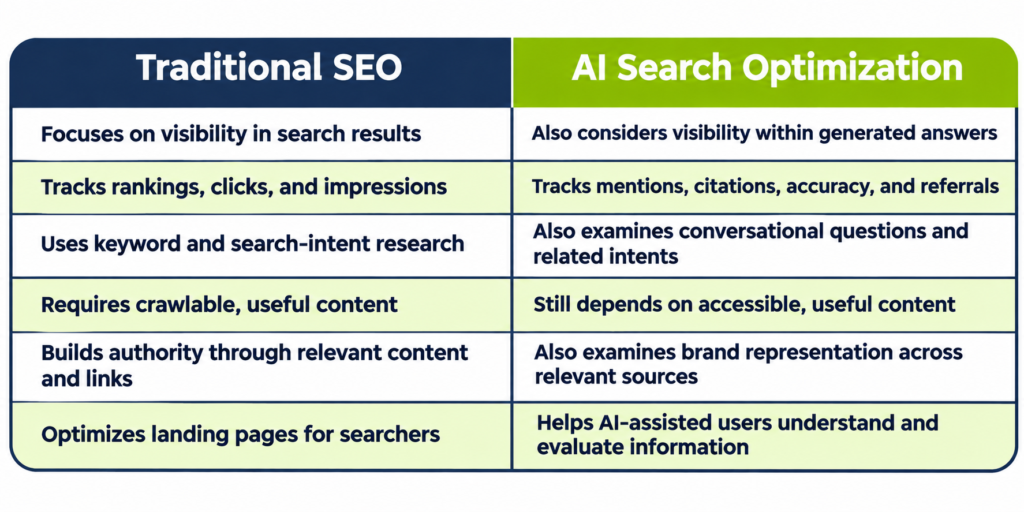
Traditional SEO and AI search optimization overlap substantially.
Generative Engine Optimization (GEO) and Answer Engine Optimization (AEO) are terms commonly used to describe approaches to improving discoverability in generated or direct-answer experiences.
They are not substitutes for technical SEO, reliable content, or a credible brand.
How to Improve AI Search Visibility: 12 Practical Steps
1. Audit Your Current AI Search Visibility
Before changing your website, establish what is currently happening.
Start by identifying the questions potential customers might ask an AI-powered search tool.
If you operate an SEO consulting business, those questions could include:
- Who can help a small business improve AI search visibility?
- What should I look for when hiring an SEO consultant?
- Which services help websites appear in AI-powered search?
- How can I compare SEO and GEO consulting services?
- What are the most common technical SEO problems affecting discoverability?
Test these questions across the AI search experiences your audience actually uses.
Record whether your business appears, how it is described, which sources are cited, and whether the response provides a link.
Use a tracking sheet like this:
| Prompt | Platform | Brand Mentioned? | Website Cited? | Description Accurate? |
| Best SEO consulting options for small businesses | ChatGPT Search | Yes/No | Yes/No | Yes/No |
| How to improve website AI visibility | Google AI Mode | Yes/No | Yes/No | Yes/No |
| SEO consultant comparison | Perplexity | Yes/No | Yes/No | Yes/No |
These are example prompts, not actual test results.
Run relevant variations and document the date, platform, location or personalization settings when available, and whether web search was enabled.
AI-generated answers can change between sessions. A single response is not reliable evidence of consistent visibility.
Practical takeaway: Establish a repeatable baseline before deciding which optimization work deserves priority.
2. Make Your Website Accessible to Search Engines and Relevant AI Crawlers
A useful article cannot contribute to a search experience that cannot access the information it needs.
Start with your technical SEO foundation.
Check whether important pages return successful HTTP responses, contain indexable content, and are accessible through normal internal links.
Review your robots.txt directives, canonical tags, noindex settings, and server responses.
For Google AI Overviews and AI Mode, Google’s documentation states that a page must be indexed and eligible to appear in Search with a snippet to qualify as a supporting link.
There are no additional technical requirements specific to those Google AI features.
Other AI services may use different crawlers and access mechanisms.
For example, OpenAI documents separate crawlers and controls for search discovery and model training.
Review the official OpenAI crawler documentation before changing access rules.
Pay particular attention to:
- Googlebot access for Google Search
- OAI-SearchBot access where ChatGPT search discovery is relevant
- Robots.txt restrictions affecting important content
- CDN or firewall rules that block legitimate crawlers
- Pages whose main content requires user interaction or authentication
- Important text rendered only through complex client-side JavaScript
Do not assume that allowing one crawler grants access to every AI search platform.
Also, don’t remove security restrictions simply to increase discoverability.
Practical takeaway: Confirm that the content you want discovered is accessible to the search and retrieval systems relevant to your audience.
3. Give Every Important Page a Clear, Direct Answer
Think about what happens when someone lands on a page titled “How to Improve AI Search Visibility.”
They want to know what to do.
They don’t need several paragraphs explaining that technology is changing before receiving an answer.
Start important informational pages with a concise explanation that directly addresses the main question.
Then provide the details necessary to act on it.
For example:
Question: How can a service business improve AI search visibility?
Direct answer: Improve technical accessibility, clearly describe your services, publish useful answers to customer questions, maintain accurate brand information, and track AI-generated mentions and citations.
The remainder of the article can explain each step.
This structure helps human readers quickly evaluate whether the page meets their needs.
It also makes individual sections easier to interpret when a search or retrieval system processes the page.
Use descriptive headings and keep related information together.
Avoid turning every paragraph into a short, disconnected answer merely because you hope an AI system will extract it.
Clear structure matters, but completeness and accuracy matter just as much.
4. Build Topical Coverage Around Real Customer Questions
A single article targeting “AI search visibility” cannot answer every question someone might have about the subject.
Some visitors want a beginner’s explanation.
Others need help diagnosing crawlability problems, measuring citations, or comparing AI search platforms.
Instead of publishing unrelated articles, organize related resources around a central topic.
For an SEO consulting website, a content cluster might look like this:
Pillar guide: Complete AI Search Optimization Guide
| Supporting Content | Reader Intent |
| How to Improve AI Search Visibility | Learn practical optimization steps |
| ChatGPT Search vs. Google AI Overviews | Understand platform differences |
| How to Audit AI Crawler Access | Diagnose technical accessibility |
| How to Track AI Brand Mentions | Measure discoverability |
| SEO vs. GEO vs. AEO | Compare optimization approaches |
| How to Structure Content for AI Search | Improve clarity and organization |
Each page should address a distinct need.
Connect supporting articles to the main guide using descriptive internal links.
For example, a technical article could reference the complete AI search optimization guide when readers need a broader strategy.
A pillar guide could link to a dedicated crawler-access tutorial when the subject requires more detailed instructions.
Avoid creating separate articles for every minor keyword variation.
Practical takeaway: Build connected coverage around customer problems rather than publishing multiple pages that repeat the same advice.
5. Strengthen Your Brand Identity and Entity Clarity
Imagine asking an AI-powered search tool about a business and receiving an outdated description of its services.
That is a brand information problem.
Your website should clearly communicate who you are, what you offer, who you serve, and how customers can verify your business.
For a personal consulting brand, the homepage and About page should establish the consultant’s name, professional specialty, and services.
Service pages should explain their individual offerings instead of relying on broad marketing statements.
For example, compare these descriptions.
Vague description:
“We help businesses grow with innovative digital solutions.”
More specific description:
“SEO consulting services covering technical SEO, keyword research, content optimization, and AI search visibility for businesses seeking stronger organic discoverability.”
The second description communicates more useful information.
Apply consistent business details across your website and legitimate professional profiles.
If your business serves a particular region, explain that accurately. If you work internationally, make the service coverage clear.
Avoid adding locations you don’t actually serve.
For an SEO consultant, an accurate LinkedIn profile, author biography, portfolio, and service descriptions can help customers verify professional information.
However, consistent branding alone does not guarantee that AI systems will recognize or recommend an entity.
Practical takeaway: Make your business identity specific, verifiable, and consistent wherever customers are likely to research you.
6. Publish Original Evidence Instead of Repeating Generic SEO Advice
Search results already contain countless articles advising businesses to create quality content, build authority, and optimize their websites.
Repeating those recommendations without adding evidence gives readers little reason to choose your article.
Originality doesn’t always require conducting a large research study.
It can come from explaining a real process, documenting an observation, or demonstrating a solution.
For example, an SEO consultant could publish an anonymized technical audit showing:
- The initial website problem
- How the problem was identified
- Which tools were used
- What changes were implemented
- What results were observed
- Which limitations remain
If you have verified performance data, include the relevant dates, baseline, measurement method, and results.
If you don’t have that data, use a clearly labeled hypothetical example rather than inventing a success story.
A useful article about AI search visibility could also include screenshots of crawler diagnostics, examples of structured content, or a repeatable prompt-testing worksheet.
These elements help readers complete a task and make your content more distinctive.
Google’s helpful, reliable, people-first content guidance provides a useful framework for evaluating content quality.
Practical takeaway: Give readers information they could not obtain simply by reading another generic summary.
7. Use Structured Data to Clarify Page Information
Structured data provides machine-readable information about a page and its content.
For example, Article structured data can describe an article’s headline, author, and publication information.
Organization structured data can identify relevant business details.
Service-related structured data may describe a service where an appropriate vocabulary is supported.
However, structured data is frequently misunderstood in AI optimization discussions.
Adding schema markup does not automatically make a page eligible for an AI citation.
Google does not require special AI-specific structured data to appear in AI Overviews or AI Mode.
Use structured data where it accurately represents visible content and follows the relevant search engine’s requirements.
For an SEO consulting website, review whether the following types are appropriate:
| Structured Data Type | Potential Purpose |
| Organization | Describe an organization and its identity |
| Person | Identify an individual author or professional |
| Article or BlogPosting | Describe editorial content |
| BreadcrumbList | Clarify page hierarchy |
| Service | Describe service information where applicable |
| FAQPage | Represent eligible question-and-answer content |
FAQPage markup does not guarantee a Google FAQ rich result. Google’s display eligibility and feature support are separate from the existence of schema vocabulary.
Validate supported markup using Google’s Rich Results Test and consult Schema.org for vocabulary definitions.
Practical takeaway: Treat structured data as a way to describe content accurately, not as a shortcut to AI search recommendations.
8. Improve Internal Linking and Content Relationships
Suppose your website has a detailed technical SEO guide, a keyword research tutorial, and an AI visibility article.
If these pages are relevant but disconnected, readers may struggle to move between them.
Contextual internal links make those relationships easier to navigate.
For example, an AI visibility article discussing crawlability could link to a technical SEO resource.
A section explaining content targeting could link to a keyword research guide.
A discussion about content clusters could link to a practical content strategy tutorial.
Use anchor text that describes the destination.
Useful anchor: “technical SEO audit checklist”
Less useful anchor: “click here”
Avoid placing unrelated links simply because a keyword appears in a paragraph.
A useful internal link should help someone answer a natural follow-up question.
Your website’s broader SEO consulting resources can serve as a starting point for connecting educational content with relevant services.
Practical takeaway: Build links around the reader’s next question, not around an arbitrary number of links per page.
9. Earn Relevant Brand Mentions and Third-Party References
Your website is not the only place where customers encounter your brand.
People may discover you through industry publications, professional directories, interviews, conference presentations, podcasts, or independent reviews.
Relevant third-party references can help potential customers evaluate your credibility.
They may also make accurate information about your brand available to systems that retrieve information from those sources.
But a brand mention is not automatically an AI ranking signal, and the influence of individual mentions varies by platform and context.
Focus on earning references that have value beyond AI visibility.
For example, an SEO consultant could:
- Contribute an original technical explanation to a relevant industry publication.
- Participate in an expert interview about SEO or AI-assisted discovery.
- Publish a useful study that other writers can reference.
- Maintain accurate professional directory profiles.
- Share practical insights supported by verifiable experience.
Avoid purchasing fabricated reviews, creating fake citations, or distributing identical promotional articles across low-quality websites.
Practical takeaway: Build a reputation that real customers and independent sources can verify.
10. Optimize for Conversational and Comparison-Based Queries
Traditional keyword research often begins with short phrases.
AI-assisted search can involve longer, more specific questions.
Someone might search Google for “SEO consultant.”
The same person could ask an AI assistant:
“How do I choose an SEO consultant who understands both traditional search and AI-powered search visibility?”
The second query includes more context and a clearer decision-making need.
Your content strategy should address both kinds of searches.
For an SEO consulting business, consider topics such as:
| Customer Question | Suitable Content |
| Why isn’t my website appearing in AI search answers? | Diagnostic guide |
| Does ChatGPT use the same rankings as Google? | Platform comparison |
| How can I check whether AI crawlers access my site? | Technical tutorial |
| Is GEO different from SEO? | Educational comparison |
| What should an AI visibility audit include? | Practical checklist |
| How do I measure AI referrals? | Analytics tutorial |
Do not add dozens of nearly identical questions to one article.
Group related questions under meaningful headings and answer them with enough detail to be useful.
When a question requires its own detailed process, consider a dedicated article.
Practical takeaway: Research the complete questions customers ask, not just the shortest keywords associated with your services.
11. Improve Technical Performance and Content Accessibility
AI search optimization should not distract you from fundamental website quality.
A page that is difficult to navigate, slow to load, or inaccessible on mobile can frustrate visitors even if it receives an AI citation.
Review your site’s technical health regularly.
Important checks include:
Indexability: Confirm that valuable pages can be indexed where appropriate.
Canonicalization: Ensure canonical URLs reflect the intended versions of your content.
Internal navigation: Make important pages reachable through ordinary links.
Rendering: Confirm that essential text is available to relevant crawlers.
Mobile usability: Make content readable and interactive on smaller screens.
Page performance: Identify loading and responsiveness problems that affect the user experience.
Security: Maintain HTTPS and avoid unnecessary exposure of private information.
Content consistency: Keep important facts aligned across visible page content, metadata, and structured data.
Use Google Search Console for indexing and search diagnostics and PageSpeed Insights for performance analysis.
Improving page speed alone does not guarantee AI citations. Technical optimization removes obstacles and improves the experience for people who visit your site.
Practical takeaway: Maintain a technically healthy website before investing heavily in speculative AI-specific tactics.
12. Measure AI Search Visibility, Citations, and Business Outcomes
You cannot manage AI visibility effectively by checking one ChatGPT response every few weeks.
Build a measurement framework that distinguishes visibility from traffic and conversions.
Start with four categories.
Brand visibility
Track whether your brand appears in relevant prompts and whether the description is accurate.
Source visibility
Record whether AI responses cite your domain and which pages receive citations.
Referral traffic
Monitor visits from identifiable AI-powered sources using your analytics platform.
Business outcomes
Measure relevant enquiries, sign-ups, or other meaningful actions from visitors where attribution is available.
| KPI | What to Track | Measurement Method |
| Brand mention rate | Mentions across a defined prompt set | Repeated prompt testing |
| Citation rate | Responses linking to your website | Citation review |
| Description accuracy | Correct brand and service information | Manual evaluation |
| AI referral sessions | Visits from identifiable AI sources | Web analytics |
| AI-assisted conversions | Relevant actions linked to identifiable journeys | Conversion tracking |
| Google search visibility | Search impressions and clicks | Search Console |
For example, suppose you test 40 relevant prompts and your brand appears in 8.
Your observed brand mention rate for that particular sample is:
8 ÷ 40 × 100 = 20%
That figure is not your share of all AI search activity. It describes only the prompts, platforms, and testing conditions you selected.
Keep the prompt set consistent when comparing results over time.
Remember that some AI experiences do not expose complete citation or referral data, and privacy restrictions can limit attribution.
Practical takeaway: Measure repeatable indicators while acknowledging what your data cannot prove.
How to Optimize for Google AI Overviews, ChatGPT Search, and Perplexity
The underlying principles overlap, but each platform has different retrieval mechanisms and visibility opportunities.
| Platform | Practical Priority | Important Limitation |
| Google AI Overviews and AI Mode | Indexability, search eligibility, useful content, strong SEO foundations | No guaranteed inclusion or dedicated AI ranking shortcut |
| ChatGPT Search | Accurate public information, relevant search crawler access, useful source pages | Citations and mentions vary by query and retrieval behavior |
| Perplexity | Accessible, relevant information with clear supporting evidence | Source selection varies and is not fully controlled by publishers |
For Google, follow the official documentation rather than treating unverified GEO tactics as ranking requirements.
For ChatGPT, review the current crawler controls and distinguish search discovery from training permissions.
For Perplexity, examine its published guidance and test relevant queries rather than assuming Google-specific rules apply identically.
The goal is not to write a different version of every article for each platform.
It’s to maintain reliable information that users and different search experiences can understand.
How to Perform an AI Search Visibility Audit
An effective audit should produce a prioritized list of problems rather than a vague visibility score.
Use this workflow.
1: Technical Discovery
Inspect important URLs, indexing status, robots.txt rules, crawler restrictions, server responses, and content rendering.
Identify whether technical barriers prevent legitimate search systems from accessing relevant information.
2: Content Evaluation
Review whether your key pages answer customer questions directly.
Check headings, examples, evidence, content accuracy, and internal links.
Identify missing topics and overlapping pages.
3: Brand Accuracy
Compare the business information on your website with relevant professional profiles and trusted third-party references.
Look for outdated services, inconsistent names, or unsupported claims.
4: AI Response Testing
Create a representative set of customer questions.
Test relevant AI-powered search experiences and record mentions, citations, accuracy, and linked sources.
5: Prioritization
Classify findings according to their importance.
| Priority | Example Problem | Recommended Action |
| Critical | Important pages blocked from relevant search crawlers | Review access controls |
| High | Core service pages lack clear descriptions | Rewrite service explanations |
| High | Important customer questions remain unanswered | Improve or create targeted content |
| Medium | Relevant articles lack contextual internal links | Strengthen content connections |
| Medium | Brand profiles contain outdated information | Correct verifiable details |
| Ongoing | No AI visibility baseline | Establish recurring measurement |
A professional audit should explain what was tested, what was observed, and which recommendations are supported by evidence.
It should not promise that fixing every issue will guarantee citations.
A Practical Example: AI Search Visibility for an SEO Consulting Website
Consider a hypothetical SEO consulting website that already publishes articles about keyword research, on-page SEO, and technical optimization.
Its homepage lists several services, but the descriptions are brief.
The website has no dedicated resource explaining AI search optimization.
Its articles also contain few links connecting traditional SEO topics to AI-assisted discovery.
A practical improvement plan could begin with four changes.
First, clarify service positioning.
Update the homepage and relevant service pages to explain the business’s SEO and AI search capabilities accurately.
Second, publish a useful AI search guide.
Create a resource explaining technical accessibility, content quality, brand representation, and measurement.
Third, connect related articles.
Link relevant keyword research, technical SEO, and content strategy resources where they answer natural follow-up questions.
Fourth, establish a visibility baseline.
Test customer-relevant prompts across selected platforms and document the results.
After implementation, review whether technical access, content coverage, brand accuracy, and measurable discovery outcomes have changed.
This is an illustrative workflow, not a claim that a specific consulting website achieved particular results.
Common AI Search Optimization Mistakes to Avoid
Assuming AI Search Requires Completely Different SEO Rules
Many important fundamentals remain the same: accessible pages, relevant content, clear site structure, and reliable information.
Don’t ignore proven SEO work in favor of unverified shortcuts.
Believing Schema Markup Guarantees AI Citations
Structured data can clarify page information, but it does not guarantee inclusion in generated answers.
Publishing Large Volumes of Repetitive AI-Generated Content
More pages do not automatically create better topical coverage.
Prioritize distinct search intents, factual accuracy, and useful original information.
Confusing Brand Mentions With Website Citations
An AI system may mention your business without linking to your website.
Measure these outcomes separately.
Treating One AI Response as a Ranking Report
AI-generated responses can vary across sessions, users, locations, and retrieval settings.
Use a repeatable testing method rather than drawing conclusions from one result.
Buying Low-Quality Mentions or Fake Reviews
Artificial reputation signals can mislead customers and damage credibility.
Build legitimate references and verified customer feedback.
Ignoring Conversion Quality
An increase in AI referrals has limited business value if visitors cannot find relevant information or complete the intended action.
Connect visibility measurement with meaningful business outcomes.
30-Day AI Search Visibility Improvement Plan
You don’t need to rebuild your entire website before making progress.
Start with a manageable set of improvements.
| Timeline | Main Activities | Deliverable |
| Days 1–5 | Review indexing, crawler access, and technical health | Technical audit |
| Days 6–10 | Test customer prompts and evaluate brand accuracy | AI visibility baseline |
| Days 11–15 | Improve homepage, About page, and service descriptions | Clearer brand information |
| Days 16–20 | Update important articles and create missing resources | Improved content coverage |
| Days 21–25 | Strengthen internal links and relevant professional profiles | Connected content and accurate references |
| Days 26–30 | Configure tracking and repeat initial tests | Measurement report |
The 30-day period is an implementation framework, not a promise that visibility will improve within 30 days.
Some changes may be discovered quickly, while others require longer periods to evaluate.
Continue measuring performance after the initial implementation.
Final Thoughts: Make Your Website Easier to Discover, Understand, and Trust
Improving AI search visibility isn’t about inserting special phrases into every paragraph or creating a separate website for AI systems.
It’s about making your existing website more useful, technically accessible, and trustworthy.
Start by checking whether important pages can be discovered. Make your services and expertise easy to understand. Publish content that answers real customer questions, support important claims with evidence, and connect related resources.
Then evaluate how your business appears in relevant AI-powered search experiences.
You may not control whether an AI system recommends your website, but you can control the quality, accuracy, and accessibility of the information you publish.
Need help evaluating your website’s SEO and AI search visibility?
Explore Sonia Akter’s SEO consulting website to learn more about SEO strategy, content optimization, and AI-powered search discoverability.
Frequently Asked Questions
How can I improve AI search visibility?
Improve website crawlability, publish accurate and helpful content, clarify your brand identity, earn credible mentions, and track AI-generated citations and recommendations.
Is AI search optimization different from SEO?
AI search optimization builds on SEO fundamentals while also examining brand mentions, citations, conversational queries, and visibility within AI-generated answers.
How do I get my website mentioned in ChatGPT?
Publish useful, accessible information, maintain accurate brand details, and allow relevant search discovery where appropriate. No method guarantees a ChatGPT mention.
How do I optimize for Google AI Overviews?
Follow Google’s SEO best practices, maintain indexable content eligible for search snippets, and provide helpful answers. Google requires no special AI-specific optimization.
Does schema markup improve AI search visibility?
Structured data helps describe content, but it doesn’t guarantee AI citations, mentions, or higher visibility.
How can I track AI search visibility?
Monitor brand mentions, source citations, response accuracy, identifiable AI referral traffic, and conversions using consistent prompts and analytics.
How long does AI search optimization take?
There is no fixed timeline. Technical changes may be implemented quickly, but discovering their effect and building brand credibility can take longer.
Can AI-generated content rank in AI search?
AI-assisted content can be useful when it is accurate, original, and created for readers. Automatically generated text alone offers no visibility advantage.